Have you ever plugged a scanner into your car, seen a fault code appear, and still had no idea what was actually wrong? You’re not alone. Modern petrol and diesel vehicles are packed with sensors and control modules, and a single warning light can point to a dozen different causes, leaving drivers confused, frustrated, and sometimes paying for parts they never needed.
In this guide, we’ll explain how AI car diagnostics compares with Traditional OBD2 scanners, where each one shines, and why the right diagnostic approach can save you time, money, and stress. By the end, you will know exactly what to ask for the next time your dashboard lights up.
What Is an OBD2 Fault Code Reader?
An OBD2 fault code reader is a small diagnostic tool that plugs into the port under your dashboard and reads fault codes stored by your vehicle’s engine control unit. Those codes tell you which system has logged a problem, such as a misfire, a sensor fault, or an emissions issue.
Petrol cars sold in the UK since 2001 and diesel cars since 2004 carry this standard port, including:
- Volkswagen
- Audi
- BMW
- Mercedes-Benz
- Ford
- Vauxhall
- Peugeot
- Citroën
- Land Rover
- Jaguar
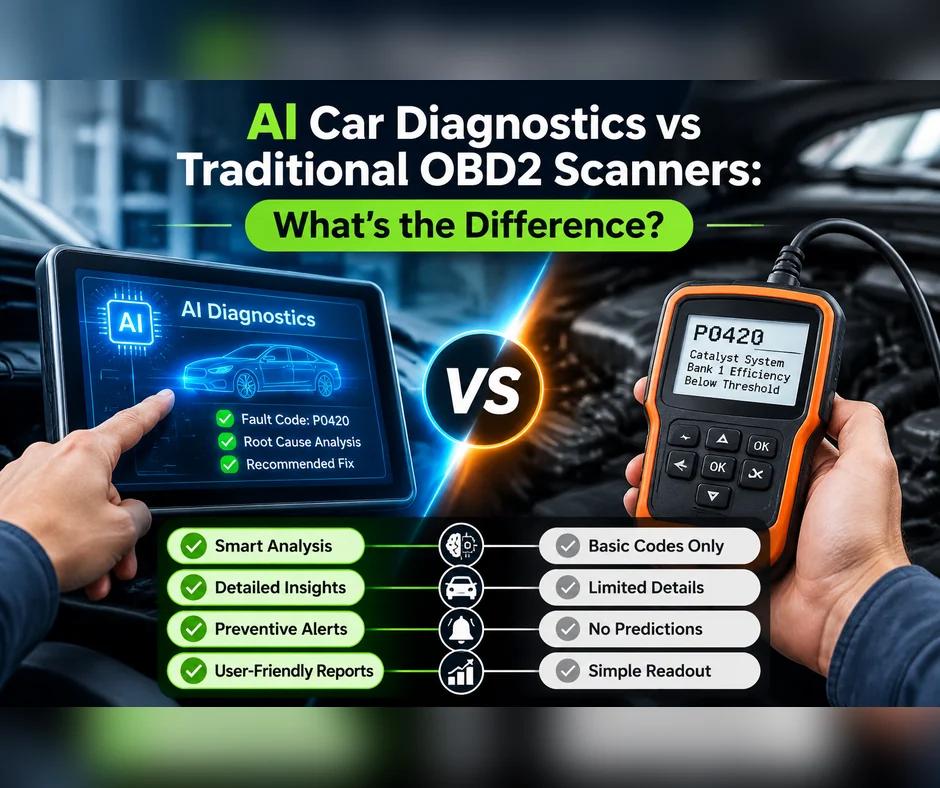
Traditional OBD2 scanners are quick, affordable, and useful for a first look. The catch is that they report what the car noticed, not why it happened.
Why Are Drivers Moving Beyond Traditional OBD2 Scanners?
Plenty of owners start with a basic tool, then hit a wall. Common reasons include:
- Codes that point to several possible causes
- Faults that return after being cleared
- Intermittent problems that never show up on demand
- Limited access to manufacturer specific data
- Confusing results on newer, software heavy vehicles
- Guesswork that leads to unnecessary part replacements
A fault code is a clue, not a verdict. Traditional OBD2 scanners hand you the clue and leave the detective work to you.
How Do Drivers Realise a Basic Scan Isn’t Enough?
Many owners only discover the limits of a simple scan after spending money. It usually happens when:
- A replaced part does not fix the warning light
- The same fault code keeps coming back
- The car runs poorly but no code appears
- Fuel economy drops with no obvious reason
- Different garages give different opinions
- The vehicle has been remapped and the data looks unusual
In these situations, reading a code is only the first step.
Signs You May Need More Than a Basic Scan
1. Repeating Warning Lights
If a light clears and returns within days, something deeper is happening that a simple code reading will not reveal.
2. Poor Performance Without a Fault Code
Hesitation, rough running, or sluggish response can exist without a stored code. Live data analysis is needed to spot the pattern.
3. Rising Fuel Consumption
A sudden drop in miles per gallon often points to sensor drift or a developing fault, long before a warning light appears.
4. A Vehicle With Software Changes
Cars with remapped or modified ECU software need someone who understands how those changes affect the data. A generic code description can easily mislead.
Why AI Car Diagnostics Is Changing the Game
AI car diagnostics uses smart analysis to look at fault codes, live sensor readings, and known failure patterns together. Instead of showing a single code, AI vehicle diagnostic software compares thousands of data points to highlight the most likely cause.
Faster Answers
Software can scan large amounts of live data in seconds, helping a specialist narrow down the problem much sooner.
Fewer Unnecessary Parts
By ranking the most probable causes, you avoid the expensive habit of replacing parts one by one and hoping for the best.
Spotting Patterns Early
AI vehicle diagnostic software can notice small changes in sensor behaviour that suggest a fault is developing, giving you a chance to act before a breakdown.
Smarter Results on Modern Vehicles
Today’s cars rely heavily on software. Advanced analysis copes far better with that complexity than a basic scanner can.
Better Long Term Reliability
Finding the true root cause means the fix lasts, protecting your fuel economy, performance, and resale value.
What Is Involved in an AI Assisted Diagnostic Check?
A proper diagnostic session goes far beyond plugging in and printing a code. A qualified specialist will typically:
- Read all stored and pending fault codes from every module.
- Record live data while the engine is running.
- Compare readings against expected manufacturer values.
- Use AI vehicle diagnostic software to highlight unusual patterns.
- Check for previous software changes or coding issues.
- Test the suspected components before recommending any repair.
- Confirm the diagnosis with a follow up scan.
- Clear fault codes and verify the issue does not return.
The goal is to find the real cause rather than simply switching off a warning light.
Can AI Car Diagnostics Replace Traditional OBD2 Scanners?
Not entirely. Traditional OBD2 scanners still have their place for quick checks and basic code reading. However, the best results come when the information is interpreted by someone with real expertise.
The outcome depends on:
- Vehicle make and model
- ECU type
- Software version
- Previous modifications
- The quality of the diagnostic equipment
AI car diagnostics adds depth and speed, but experienced specialists still make the final call.
Frequently Asked Questions
Is an OBD2 fault code reader good enough for everyday use?
Yes, for simple checks. It is a handy way to see what has been logged, but it will not always explain the cause.
Is AI car diagnostics more accurate?
In many cases, yes. Analysing live data and patterns together usually gives a clearer picture than a single code.
Can diagnostics work on a remapped vehicle?
Absolutely, provided the person carrying it out understands ECU software and how modifications affect the readings.
Will a diagnostic scan tell me which parts to replace?
A thorough scan points you in the right direction, but testing the component is what confirms it.
Professional Diagnostic Support You Can Trust
If your warning light keeps returning or a basic scan has left you with more questions than answers, it is worth having your vehicle assessed by a specialist who understands both fault codes and ECU software.
A professional diagnostic service can read every module, analyse live data, and explain the findings in plain English. Rather than guessing and paying for parts that were never faulty, you can move forward with real confidence in your petrol or diesel vehicle.
Final Thoughts: Ready to Get Real Answers?
Traditional OBD2 scanners tell you something is wrong. AI car diagnostics helps explain why. Knowing the difference can save you money, protect your engine, and keep your fuel economy where it should be.
Contact the MPG Tuning team today to book a diagnostic assessment and find out exactly what your vehicle is trying to tell you.